
Water Heater Replacement Cost in Missouri: 2026 Guide
By Instant Water Heaters
Key Takeaways
- Most water heaters fail at the tank, so replacing a unit that is 10 to 12 years old before it leaks can prevent water damage to floors, furnishings, and structure.
- Knowing a tank's age and condition before it fails turns an emergency replacement into a planned, comparable decision.
- Sediment control is the homeowner's best lever against premature failure: draining a few quarts from the tank every few months keeps the burner or element transferring heat efficiently instead of fighting a mineral layer.
Legal Disclaimer
This article is for general informational purposes only and does not constitute legal advice. Consult a qualified attorney for guidance on your specific situation.
# Water Heater in Missouri: What Replacement Costs in 2026
## How Much Does a Water Heater in Missouri Cost to Replace in 2026?
A water heater in Missouri refers to the tank or tankless appliance that stores and heats potable water for a home, delivering hot water on demand and protecting the household from cold-water interruptions. When it fails, the priority is restoring hot water fast, at a price the homeowner understands before any work begins.
Explore water heater replacement in Ballwin to see how the process works in a St. If you answer yes to any of these, it may be time to replace the unit.
Why Water Heater Age and Condition Matter
Understand what a water heater actually is and why its age and condition decide whether you repair it or replace it. A storage tank water heater holds a reservoir of water and keeps it hot around the clock until you draw it. Its tank is the one part that cannot be repaired once corrosion reaches the steel, and that single fact is why timing matters more than brand or price. The U.S. Department of Energy estimates the average product lifetime for storage tank water heaters to be around 15 years, and routine maintenance helps you reach that number. In its commercial water heating rule, the Federal Register reports lifetimes estimated to range from 10 years for commercial gas-fired storage water heaters to 25 years for instantaneous water heaters and hot water supply boilers, which shows how much design and fuel type move the clock. Losing it turns one appliance failure into a household emergency, and that urgency is exactly why knowing the age and condition of the water heater in Missouri homes depend on before it quits saves you from an expensive, panicked decision. Louis region sees the same hard-water and aging-tank patterns, which is why Ellisville homeowners weighing the same decision often start by checking a unit's age. Treat the age of your tank as a countdown, not a surprise.
Why Does Your Water Heater Fail, and What Warning Signs Come First?
Check the water at a hot tap first. Rust-colored or brown water, a popping or rumbling sound, or a puddle at the base usually points to one of a few predictable failures on a water heater in Missouri: sediment collecting on the tank bottom, a spent sacrificial anode rod, a failing heating element or thermostat, or a tank that has simply reached the end of its service life. According to the Portland Water Bureau, rust-colored water or a leaking tank means the sacrificial anode no longer works, which can lead to tank corrosion or failure.
Sediment is the quiet culprit. Dissolved minerals settle out of heated water and harden on the tank floor, where they insulate the burner or element from the water above it. The University of Florida IFAS Extension advises tank owners to drain about a quart of water from the tank every 3 to 6 months to remove sediment that slows down heat transfer and lowers efficiency. Skip that step and the unit runs longer, costs more to operate, and wears out sooner. Homes in the St. At Instant Water Heaters, our licensed plumbers serving St Louis, MO, Chesterfield, and Kirkwood see this pattern constantly in older homes that have never had a flush.
If you are weighing whether to repair or replace, the 2026 cost guide walks through realistic pricing by unit type, so you can compare a repair quote against a full replacement with real numbers in hand.
The University of Florida IFAS Extension notes that most water heaters last 10 to 15 years, and that if your water heater is more than 10 years old, it is a good idea to start shopping for a new one now. Schedule a diagnostic visit and a licensed professional can confirm which component is failing before a small repair becomes a flooded utility room.
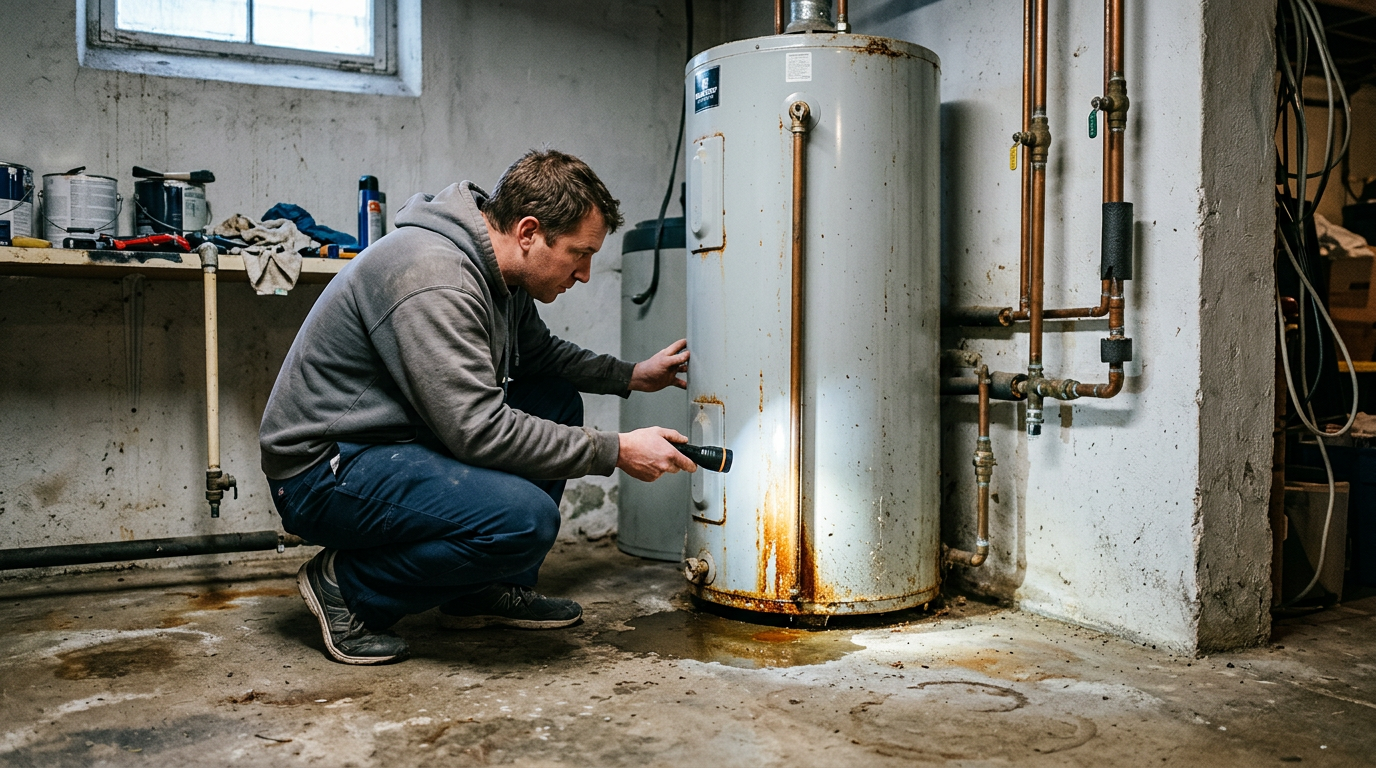
- Rust-colored or brown hot water while the cold water runs clear: the sacrificial anode rod is likely spent and the tank interior may be corroding
- Popping, rumbling, or banging during a heating cycle: sediment has accumulated on the tank bottom or around the lower element
- Water that never gets as hot as it once did, or runs out faster: a failing heating element, thermostat, or dip tube
- A puddle, rust streaks, or corrosion at the base of the tank: a compromised tank body, which generally cannot be repaired
- A sulfur or rotten-egg odor in hot water only: bacteria interacting with the anode rod
- White plastic particles in the water: a dip tube breaking down inside the tank, per the Portland Water Bureau
- Any sign of active leaking: shut off the water supply and gas or power to the unit, then arrange service promptly
- A unit more than 10 years old showing two or more signs: treat replacement as the likely path rather than a repair
- No visible warning but rising energy use: sediment buildup can lower efficiency even before symptoms appear
- Recurring tripped breaker or pilot outage on a gas unit: an electrical, gas, or venting fault that needs a qualified technician
Rule of thumb: two signs or a decade
- One warning sign on a newer tank usually points to a single fixable part: an element, thermostat, valve, or anode rod.
- Two or more signs on a tank nearing ten years old generally favor replacement over repair, because a repaired unit tends to surface the next failure so on after.
- A leak from the tank body itself is the one symptom that almost never gets repaired; plan for a new unit and limit the water damage in the meantime.
Quick Facts
- 3 to 6 months – How often the University of Florida IFAS Extension recommends draining about a quart of water from a tank to clear sediment
- 10 to 15 years – Typical service life of a water heater, per the University of Florida IFAS Extension
- More than 10 years – The age at which the University of Florida IFAS Extension suggests starting to shop for a replacement
- Anode rod – The component the Portland Water Bureau points to when hot water runs rust-colored or the tank leaks
What Is the Installation Process for a Water Heater in Missouri?
Follow a fixed sequence: confirm the diagnosis, pull any local permit, remove the old tank, install the new unit to code, then restore and test the hot water. Skipping a step is what turns a one-day job into a week of cold showers. Missouri adds its own wrinkle, because there is no statewide plumbing license. Licensing and permits are handled by cities and counties, so who can legally do the work, and what paperwork the job needs, changes the moment you cross a municipal line.
It pays to know the order before anyone touches your plumbing. The sequence below reflects how a typical replacement actually unfolds once a qualified provider is on site. Your number one concern should be speed: hot water restored, with no wasted days waiting on a callback. A concierge service can compress that timeline by matching you with a local plumber and coordinating the work, which is exactly what Instant Water Heaters is built to do. The alternative, calling one plumber after another and waiting for callbacks, is the slowest possible route to a working tank.
Who Is Legally Allowed to Do the Work?
Because Missouri does not license plumbers at the state level, the trade is regulated city by city and county by county, and a license earned in one jurisdiction does not automatically carry to the next. That is why verifying local credentials is the single most important step. Before work begins, confirm the contractor holds the license, bond, and insurance your city or county requires, and ask who pulls the permit. Local requirements commonly include a passing score on a trade exam, a surety bond, and proof of general liability coverage, and the exact figures often differ from one town to the next. For a Fenton replacement, ask any provider to confirm the current Fenton requirements before you book.
What Happens on Installation Day?
On install day, the crew shuts off the gas, water, and power, drains the old tank, and disconnects the plumbing and venting. They then set the new unit, reconnect the water lines, gas or electrical supply, the temperature and pressure relief valve, and the venting, and fill the tank before restoring power. Codes also require a drain pan and proper venting, so the replacement should mirror the safety layout of the original install, not cut corners around it. Expect the unit to be sized to your household, since an undersized tank will not keep up with demand and an oversized one costs more to run.
Timing is worth planning around. Ask your provider what the realistic window looks like for your setup before install day, and clear a path to the unit so the crew can work without delay.
- Confirm the diagnosis: age, leaks, or a failed element usually mean replacement, not repair.
- Check 811 before any digging: call your state's 811 center if the job involves excavation or a new line route.
- Pull the permit: the installing plumber should confirm the local permit and inspection requirements first.
- Isolate utilities: shut off the gas, water, and electricity to the unit.
- Drain and disconnect: empty the old tank and remove the water, gas, or electrical connections and venting.
- Install to code: set the new unit, reconnect the supply lines, T&P valve, venting, and drain pan.
- Restore and test: refill the tank, restore power or gas, then check for leaks and confirm hot water at the tap.
Permits Vary by Town
- Because Missouri licensing and permit rules live at the local level, requirements can differ between neighboring towns and change over time.
- Never assume that a job permitted in one city is automatically covered in the next.
- One final safety note: never cap, plug, or remove a temperature and pressure relief valve to stop a drip. That valve releases excess pressure, and disabling it removes a critical safeguard on the tank.
Which Water Heater Option Fits Your Missouri Home?
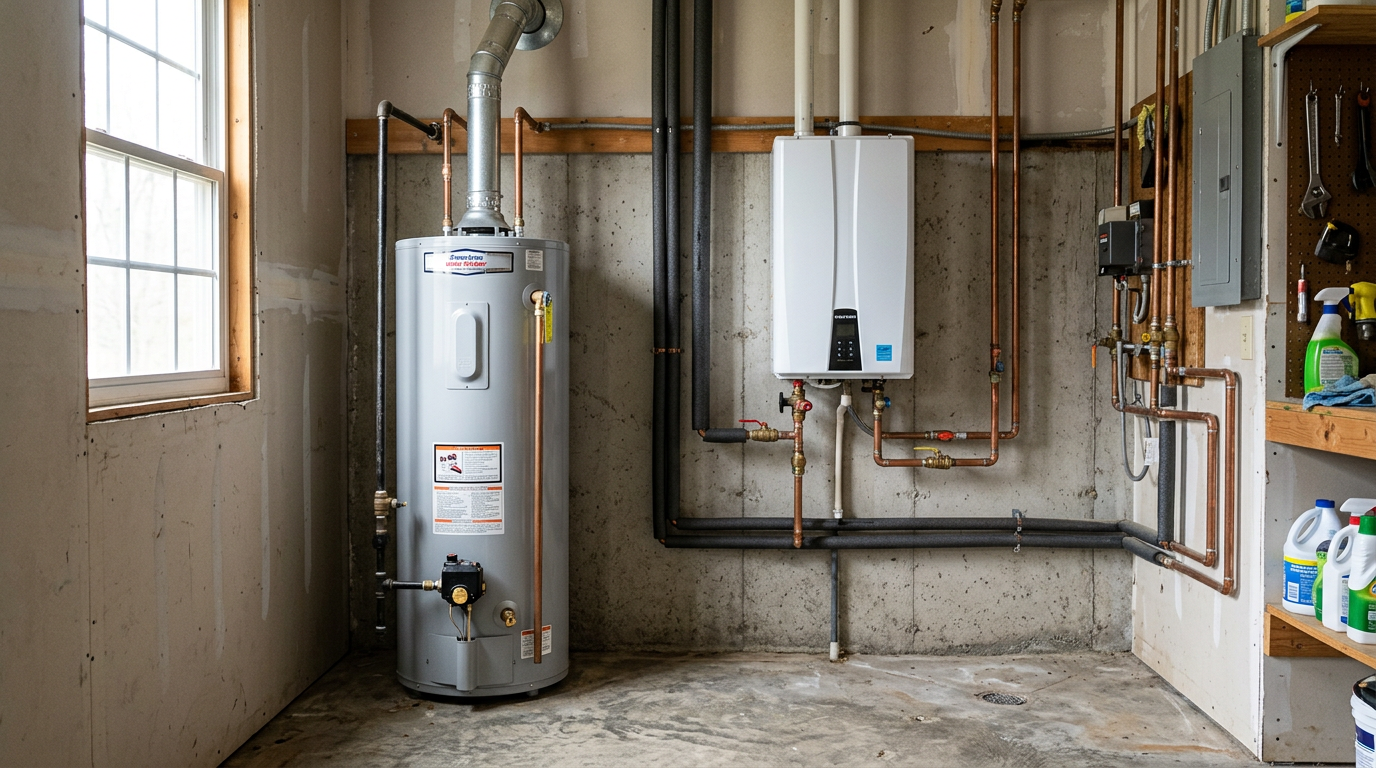
Compare three main paths before you buy: repair, like-for-like tank replacement, or an upgrade to tankless or heat pump technology. Start by matching your household size and available electrical capacity to the option, then weigh upfront price against lifetime energy cost. According to the U.S. Department of Energy, water heating is responsible for roughly 13% of both annual residential energy use and consumer utility costs. That single figure explains why the option you pick matters well beyond the install day.
Your practical first step is to write down three things: how many people live in the home, whether you have natural gas or only electric service, and how long you plan to stay. A standard electric storage tank has long been the default in Clayton and across the region, because its installed cost is the lowest and any licensed plumber can swap it quickly. A gas storage tank costs a little more but generally recovers hot water faster for larger families. Tankless gas units free up floor space and, per ENERGY STAR, carry a 20-year life expectancy that is much longer than a conventional tank-type unit.
The table below compares the four main paths with installed-cost and lifespan figures documented by DOE, ENERGY STAR, and EIA.
|
Option |
Documented Efficiency (UEF) |
Documented Lifespan |
Installed Cost Figure |
|---|---|---|---|
|
Heat pump water heater (electric) |
Not stated in cited source; DOE expects it to cut about $1,800 in utility costs over the appliance's life |
About 13 to 15 years (EIA) |
$1,500 to $2,000 for a 50-gallon 240-volt unit (ENERGY STAR, spring 2024) |
Get Professional Help Today
The Federal Trade Commission advises homeowners to consider only contractors who are licensed and insured, and to check with your state or county government to confirm a contractor's license and ask for proof of insurance. The same guidance says to get multiple estimates, because competing written numbers reveal what a fair range looks like for your address and unit. For homeowners around High Ridge, we schedule replacement within minutes and often complete it within hours, with concierge coordination handling the match so you are not calling around for quotes. Connect with us to lock in a licensed installer for your Missouri home. Contact us today.
Frequently Asked Questions