
How Long Do Tankless Water Heaters Last: Lifespan Factors and Tank Comparisons
By Instant Water Heaters
Table of Contents
Key Takeaways
- A tankless water heater has no tank to corrode, so how long it lasts comes down to how well its heat exchanger and burner are protected from mineral scale, especially in hard-water are as.
How Long Do Tankless Water Heaters Last?
Most tankless water heaters last 20 years or more with basic care, which is the standard answer to how long do tankless water heaters last. That outlasts a conventional tank model, which often wears out after 10 to 15 years. The design advantage is documented: according to the [U.S. And if your unit has already failed, Instant Water Heaters can connect you with a licensed local plumber who restores hot water fast.
Why Does Tankless Water Heater Lifespan Matter?
A tankless water heater's lifespan is the number of years a unit can heat water reliably before replacement, and it matters because that number shapes your maintenance routine, your repair-versus-replace judgment, and the timing of any upgrade you plan for your home. A tankless water heater is a compact heating unit that supplies hot water as needed and does not store hot water, according to the U.S. Department of Energy, in its tankless water heater guide. The core question behind all of this is the one every homeowner eventually asks: 'how long do tankless water heaters last?' The honest answer depends on the model, how hard the unit works, and the upkeep it receives. When that evaluation is due, licensed plumbers connected through Instant Water Heaters can inspect the heater and explain what its age means for the options ahead.
What Causes Tankless Water Heaters to Fail?
Most tankless water heaters that fail early share three killers: limescale buildup on the heat exchanger, a failing gas valve or ignition component, and skipped annual maintenance. So when you ask us how long do tankless water heaters last, the honest answer is that it depends less on the model and more on whether you notice these early signs. The good news: none of these require a full teardown to diagnose, and a flat-rate visit usually settles it.
Why Does Scale Shorten Tankless Heater Life?
With no tank to rust out, a tankless unit's corrosion story differs from a conventional heater: because tankless heaters do not store water, they are less prone to corrosion than tank-type heaters, per the Energy Department's tankless guide. Once scale coats the exchanger, the burner works harder for the same output, and internal parts wear faster.
Should You Flush Your Tankless Heater Yearly?
One flush costs a small fraction of a replacement, and it is the single biggest factor in whether your unit reaches the end of its expected service life.
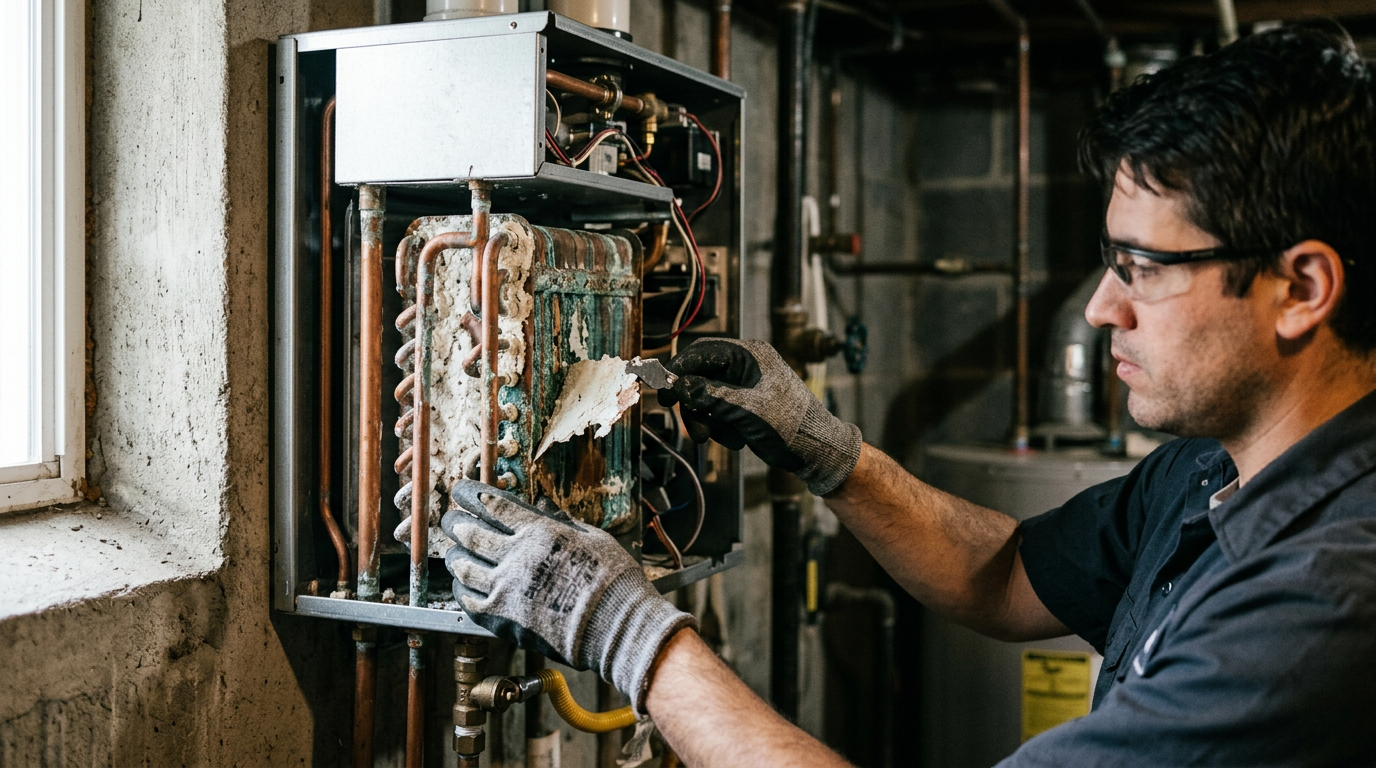
- Limescale buildup: a chalky white crust around fittings, or a gradual drop in hot-water output as minerals coat the exchanger.
- Repeating error codes: a display or LED pattern that clears after a reset but comes back within days means a component is struggling.
- Slower hot water at the tap: the first hot water from a distant fixture takes noticeably longer than it did last season, even though the unit looks healthy.
- Unusual burner sounds: clicking, rattling, or a loud roar at start up usually points to scale or a burner that needs cleaning.
- Climbing energy bills: a scaled exchanger burns more fuel for the same hot water, so the gas bill creeps up before anything else changes.
- Moisture or white residue around the gas valve or inlet fittings: a small leak is early internal corrosion showing itself.
Expert note
- An error code that clears after a reset and returns within a week is a service request, not a nuisance.
- Book the inspection while the code is fresh: the fix is usually a flush or a small part, while the same code left alone can become a burned-out heat exchanger.
- If the unit starts shutting down mid-shower, call or text a licensed plumber the same day instead of waiting for it to fail completely.
Quick Facts
- 10-20% – the range of water-heating bill savings a tankless unit can deliver, per U.S. Department of Energy guidance
- 0.82 – energy factor of gas tankless units, versus about 0.60 for conventional, per the U.S. Department of Energy
- 5+ GPM – hot-water flow of common residential gas tankless models, heating more than 5 gallons per minute by 60 degrees, per U.S. Department of Energy guidance
How Does a Tankless Water Heater Work?
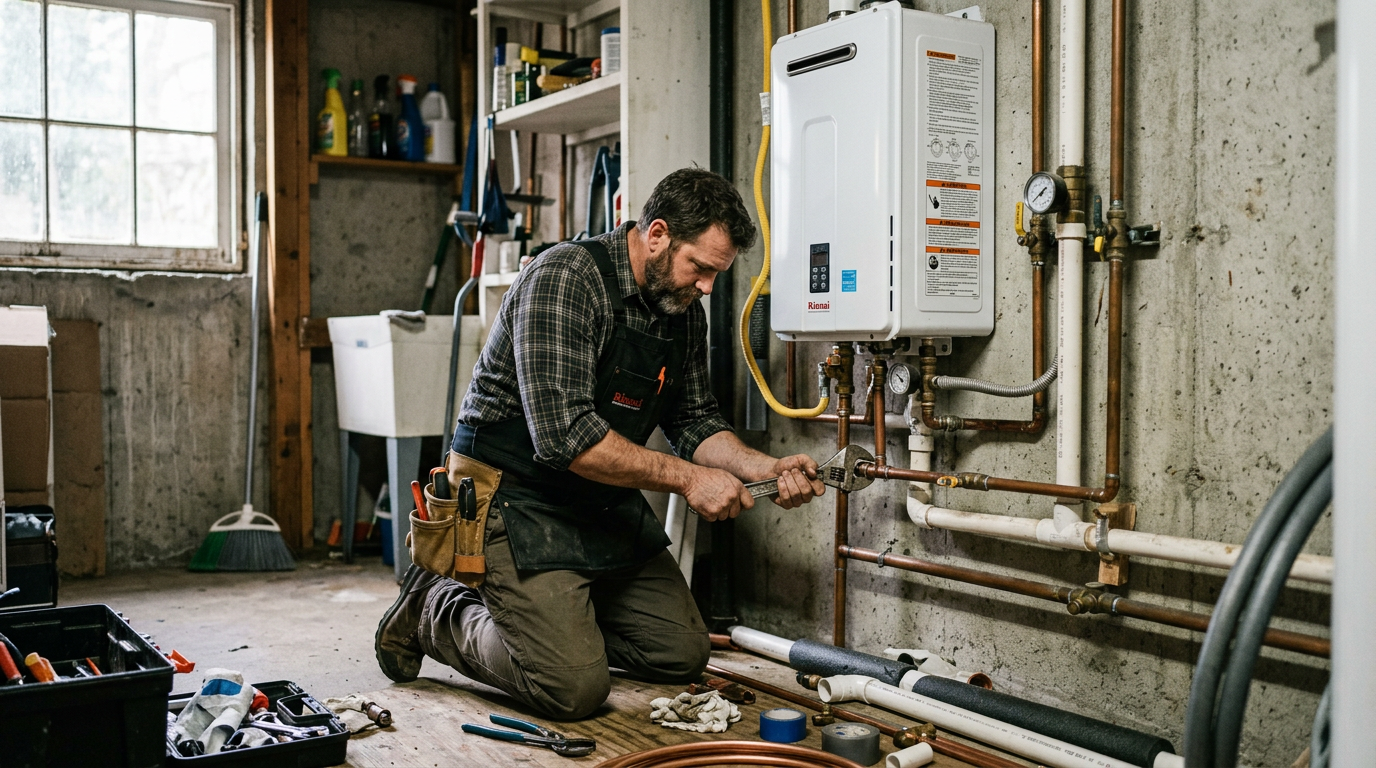
A tankless water heater makes hot water the moment you need it, instead of keeping a full tank warm. That on-demand design is the core reason these units can outlast tank-based rivals, and it starts with what happens inside. Open a hot water tap and cold water is drawn in and flows through a heat exchanger. A flow sensor detects the moving water and tells the gas burner or electric element to fire. The water heats to your preset temperature as it passes through, and the first drops from the tap are warm. Close the tap, the flow stops, and the heating element shuts off. There is no tank sitting idle or slowly leaking heat. Because nothing is stored, the failure pattern shifts. A conventional tank water heater is only as durable as the metal vessel that holds water day and night, and that vessel corrodes from the inside. A tankless unit has no reservoir to rust through. The U.S. Department of Energy, in an overview of tankless water heaters, notes that tankless heaters are less subject to corrosion than tank-type water heaters because they don't store water. The parts that actually wear are the heat exchanger, the burner, and the electronics. That is why water quality shapes the answer to how long do tankless water heaters last. If you're unsure, Instant Water Heaters can connect you with a licensed local plumber.
A maintenance caveat
- Because a tankless heater has no tank, water still passes over a heat exchanger where mineral scale can settle. That heat exchanger is the unit's main wear point, not a tank. An annual descaling flush is a widely recommended habit for keeping it clean, and in hard-water are as it can be the difference between a unit that runs for years and one that loses efficiency early.
Tankless or Tank: Which Option Lasts Longer?
According to the DOE tankless guide, a 2009 U.S. Most buyers start with the question, "how long do tankless water heaters last?" With consistent annual maintenance that prevents mineral buildup, a tankless unit can reach its potential 20-year lifespan, per Utilities for My Home. The tradeoff is cost: upfront installation costs for tankless units are significantly higher than standard tank models, often because of gas line or electrical upgrades, per this tankless guide. The table below lays the options out side by side.
|
Option |
Typical Lifespan |
Energy Factor (EF) |
Key Tradeoff |
|---|---|---|---|
|
Gas tankless (standard) |
potential 20-year lifespan with annual maintenance, per Utilities for My Home |
~0.82, per the DOE tankless guide |
higher upfront cost from gas line or electrical upgrades, per this tankless guide |
|
Gas tankless (condensing) |
same 20-year lifespan with annual care, per this pros-and-cons guide |
0.95 or higher, per the DOE guide |
can cut water-heating bills by 10 to 20%, per the 2009 DOE guide |
|
Traditional gas tank |
more subject to corrosion than tankless, per the DOE guide |
~0.60, per the 2009 DOE guide |
average household spends 14% of its energy budget on water heating, per the DOE guide |
Ready to Get Hot Water Back?
If your tankless water heater is failing, we match you with a licensed local plumber in minutes, and the replacement is often completed within hours. You get upfront flat-rate pricing, manufacturer and workmanship warranties, and 24/7 support, with no hidden fees. When you're ready, schedule your replacement and we'll get your hot water back fast.
Frequently Asked Questions