
How to Descale a Tankless Water Heater: A Guide to Flush Schedules, Scale Causes, and Professional Help
By Instant Water Heaters
Key Takeaways
- Tankless descaling is really a water-quality question: makers publish an annual flush as the starting point, and harder or heavily used water pulls that interval shorter.
- Scale works against a tankless unit on two fronts, cutting heat transfer and flow while shortening the heat exchanger's life, so a hardness test sets the schedule better than a calendar does.
- Catching scale early means acting on fixture clues such as weaker flow or a unit that quits mid-shower, because scale and lime can shorten a water heater's lifespan while the buildup stays invisible from outside.
- When a homeowner's own flush no longer clears stubborn scale, a licensed pro can descale the unit or fit a replacement, with flat-rate pricing agreed before the work starts.
Why Learn How to Descale a Tankless Water Heater?
Flush the heat exchanger with a descaling solution at least once a year, and sooner if your tap water tests hard. Knowing how to descale a tankless water heater protects the part that makes an on-demand unit work, the heat exchanger that fires only when a faucet opens. Scale starts as dissolved minerals and hardens on that hot surface.
Descaling, often called flushing, is the service step that dissolves the mineral coating inside a tankless unit. The U.S. Geological Survey explains how it forms: hardness comes from compounds of calcium and magnesium, and when hard water is heated, solid deposits of calcium carbonate can form. That scale can reduce the life of equipment, raise the costs of heating the water, and clog pipes.
That makes this a performance task, not a cleanliness favor, and weak flow is also easy to mistake for a capacity problem, which is why our guide to sizing a tankless water heater starts with peak demand and temperature rise instead of guesswork.
Louis area homeowners with pre-vetted local plumbers in real time, including help with tankless water heater installation when a unit is aging out.
- Scale forms from minerals, not dirt: the U.S. Geological Survey traces hardness to compounds of calcium and magnesium, and calls the result scale buildup after long-term movement of hard water through a pipe.
- That coating works against the heater: Rinnai states that scale and lime can shorten the water heater's lifespan over time.
- Noritz says mineral buildup can reduce heat-transfer efficiency, restrict water flow.
- The published maker baseline is annual: Rinnai says to flush mineral deposits at least once a year.
- Your water decides the real schedule: Rinnai notes the interval between maintenance visits depends on the water quality in your home, and Noritz says systems exposed to hard water or high usage may require more frequent maintenance.
- Start with the quick win: Rinnai says the in-line screen filter should be checked periodically for debris and cleaned.
Rule of Thumb: Test Your Water Before You Set a Schedule
- Both makers treat annual service as the floor, not the ceiling. Rinnai sets the interval by your home's water quality, and Noritz says systems exposed to hard water or high usage may require more frequent maintenance.
- Run a hardness test first, then match the cadence to the band rather than to the calendar. If the result lands in the very hard band, above 180 mg/L as calcium carbonate, ask your plumber about coming back sooner than twelve months.
|
Water hardness band (mg/L as calcium carbonate) |
USGS label |
Flush cadence the makers state |
Documented effect of scale |
|---|---|---|---|
|
0 to 60 mg/L ( USGS classification) |
Soft |
Rinnai: flush mineral deposits at least once a year |
USGS: hardness is caused by compounds of calcium and magnesium |
|
61 to 120 mg/L |
Moderately hard |
Rinnai: flush periodically to keep the unit free of scale and lime |
USGS: solid deposits of calcium carbonate can form when hard water is heated |
|
121 to 180 mg/L |
Hard |
Noritz: systems exposed to hard water or high usage may require more frequent maintenance |
Noritz: mineral buildup can reduce heat-transfer efficiency and restrict water flow |
|
More than 180 mg/L |
Very hard |
Rinnai: flush mineral deposits at least once a year |
USGS: scale can reduce the life of equipment, raise the costs of heating the water, and clog pipes |
What Causes Scale, and How Can You Tell?
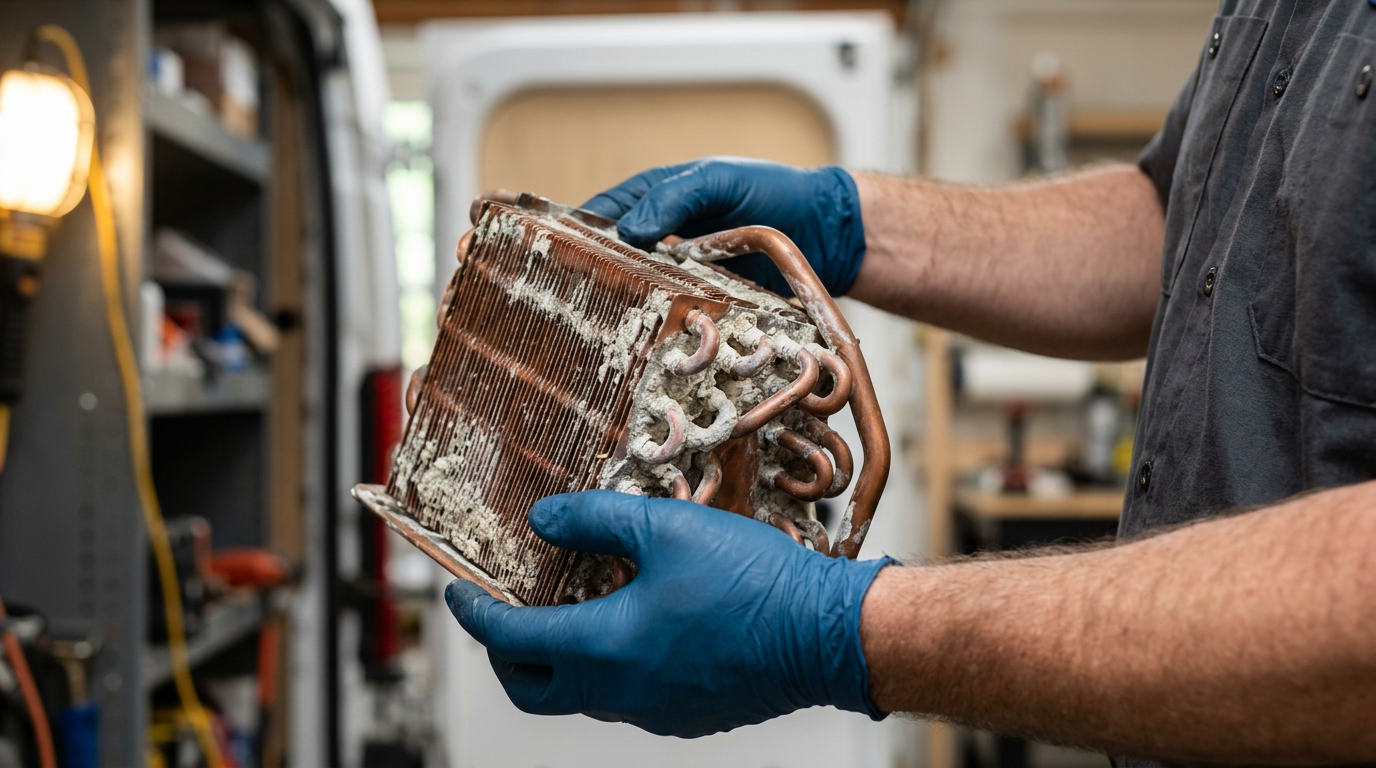
Scale forms when dissolved minerals in your household water harden onto the heat exchanger inside a tankless unit. They arrive with every gallon you draw, and the exchanger's intense heat leaves them behind, layer by layer, until flow and temperature both suffer.
Most homeowners start researching how to descale a tankless water heater only after the shower cools mid-rinse. Rinnai's maintenance FAQ states that the unit "should be flushed periodically to keep it free of scale and lime, which can shorten the water heater's lifespan over time," and it notes that the time in between necessary maintenance depends on the water quality in your home.
If the exchanger is truly worn out, we connect you with tankless installation in Kirkwood or replacement in Chesterfield, MO, coordinated in one visit instead of a string of callbacks.
Scale by the numbers
- 0.4 to 0.6 GPM – Ignition flow floor for Rinnai gas tankless models
- 0.26 GPM – Flow needed to keep the unit in operation, per Rinnai
- Two checks – Routine service items: in-line screen filter cleaning plus a scale and lime flush
- Water quality – What Rinnai says sets the time in between necessary maintenance
Get Professional Descaling Help Today
If a flush leaves your tankless unit underperforming, our licensed, pre-vetted contractors can descale it or install a new one. Book your service and Instant Water Heaters will get your hot water back.